How to increase alkalinity in a hot tub quickly 

Low alkalinity is one of the quickest ways to throw your hot tub water out of balance. Once it drops, the pH becomes unstable, water turns cloudy, and your heater, jets and shell become more vulnerable to damage. 

The longer you leave it, the worse the problem can get. Fortunately, raising hot tub alkalinity is quick, inexpensive and easy. Here’s exactly how to do it.
Why alkalinity matters for a hot tub

Alkalinity keeps your water steady. When it’s too low, your pH won’t stay put no matter how often you adjust it. A low pH leads to itchy skin, cloudy water and worn-out equipment. 

Alkaline low in hot tub? Here are the telltale signs:

  • pH reads below 7.2 no matter how often you adjust it
  • pH keeps bouncing around even after you’ve corrected it
  • Metal fittings, jets or the heater show signs of corrosion or staining
  • Water looks cloudy or foams more than usual
  • Skin feels dry or itchy, and eyes sting after a soak
Good to know: Rainwater getting into the tub and Trichlor chlorine tablets are both naturally acidic, so they’re common reasons alkalinity keeps dropping again even after you’ve corrected it. If chlorine levels are part of the puzzle too, see our guide on how to lower chlorine in a hot tub. 

Here is what happens if you leave low hot tub alkalinity untreated:

  • Corrosion. The metal fittings, heaters and pumps in your hot tub wear out faster.
  • Etched or pitted surfaces. The acrylic shell of your hot tub can be damaged over time.
  • Poor sanitiser performance. Chlorine or bromine works less effectively in acidic hot tub water.

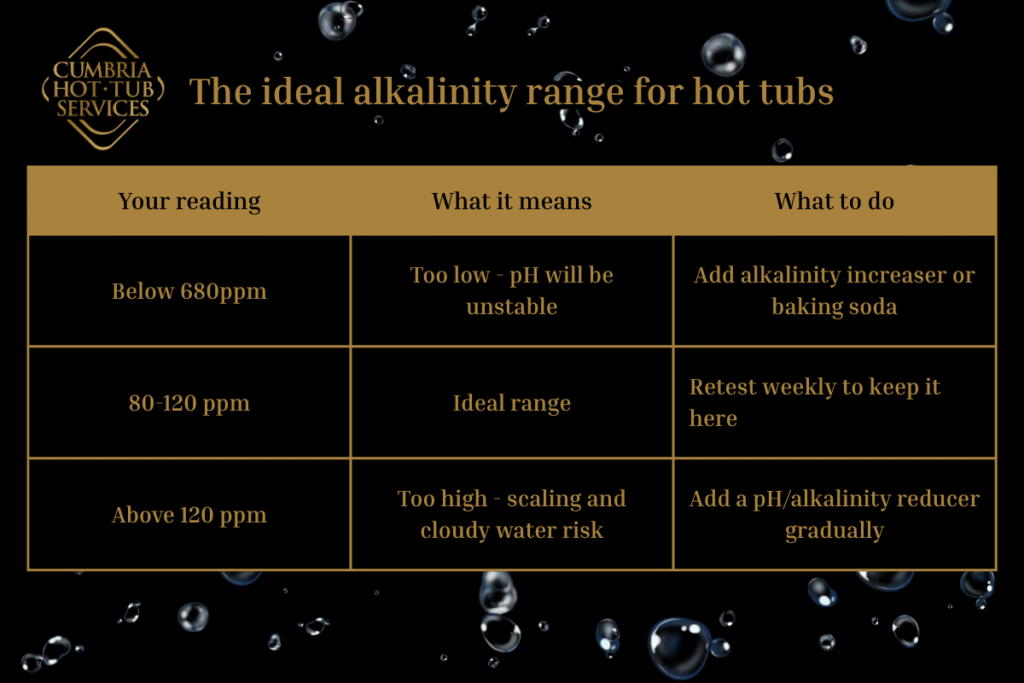
The ideal alkalinity range for hot tubs

The recommended alkalinity range for hot tubs is between 80-120 ppm total, and a pH of 7.2-7.6. Knowing how to adjust alkalinity in your hot tub starts with understanding that alkalinity and pH are linked but not the same. You should always correct your hot tub’s alkalinity first, since fixing pH alone won’t stabilise it if alkalinity is off. 

Use the table below to see what your reading actually means and what to do about it:
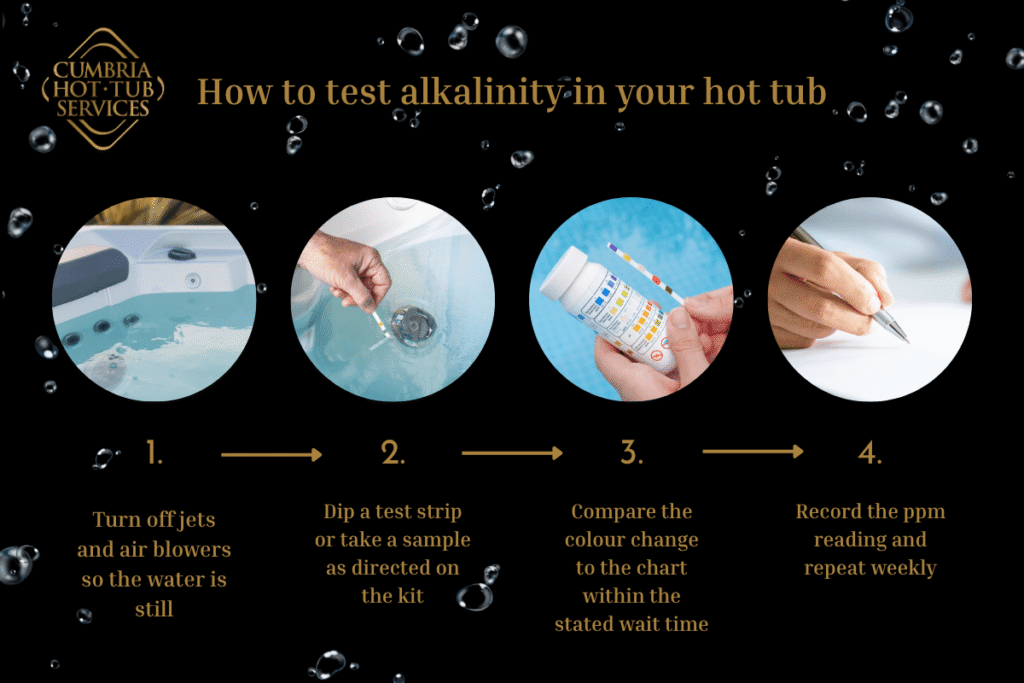
How to test alkalinity in your hot tub

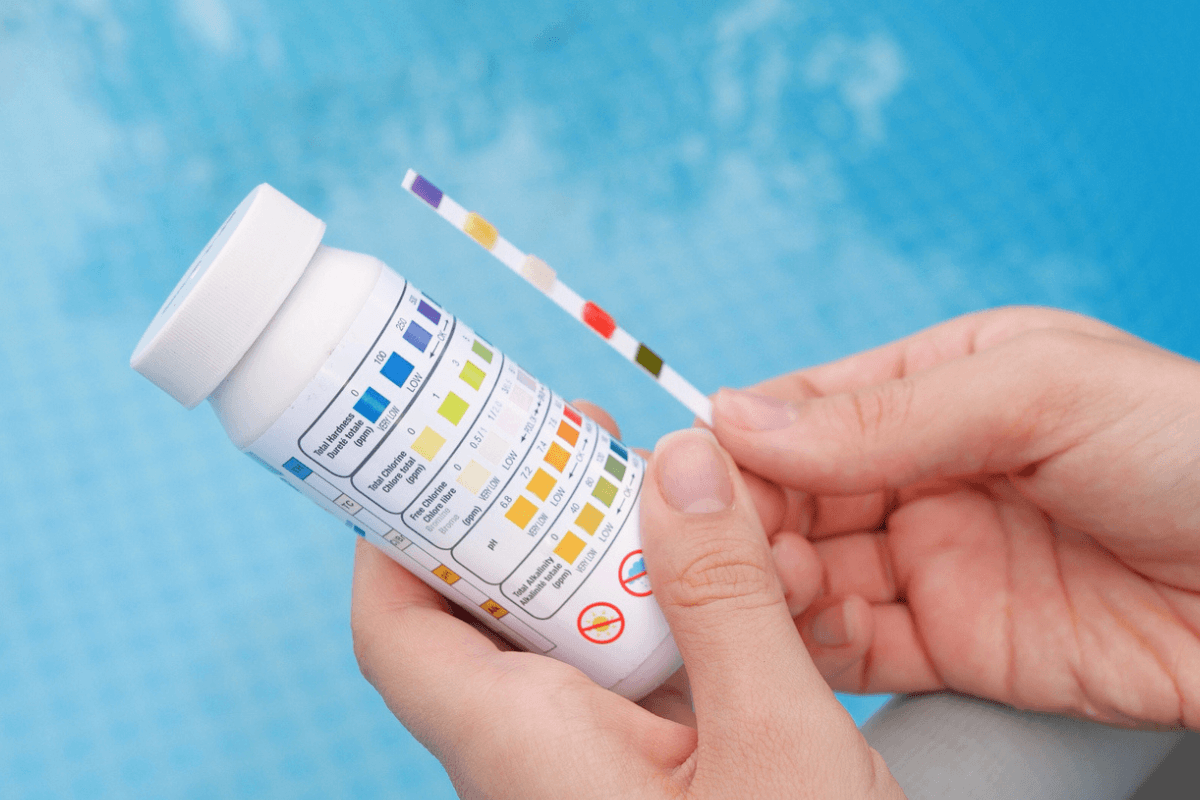
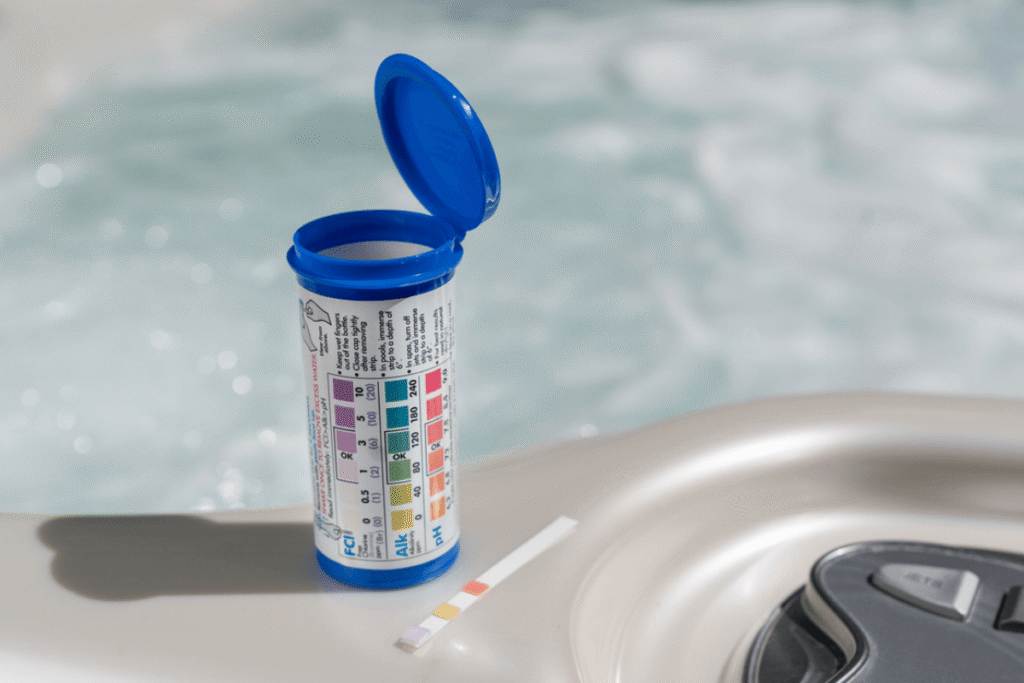
Test the alkalinity of your hot tub with test strips or a digital tester before every chemical addition – never guess the dose. 

Here are 4 easy steps to testing the alkalinity of your hot tub:
Top tip: Invest in a digital pH tester which gives a more precise ppm reading if you’re dosing regularly or managing more than one tub.

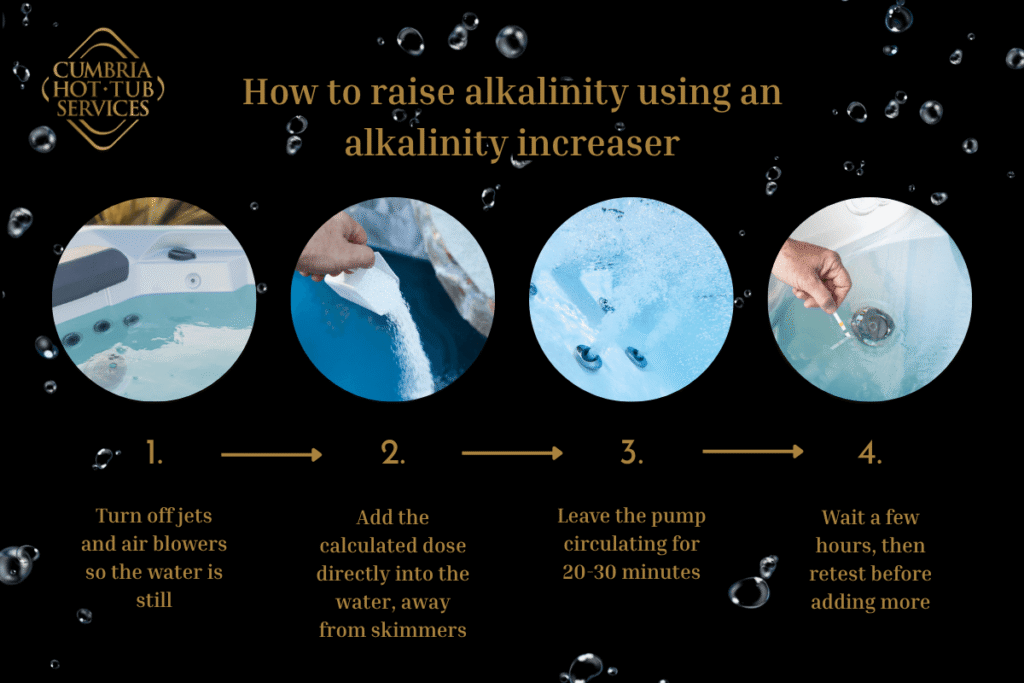
How to raise alkalinity using an alkalinity increaser

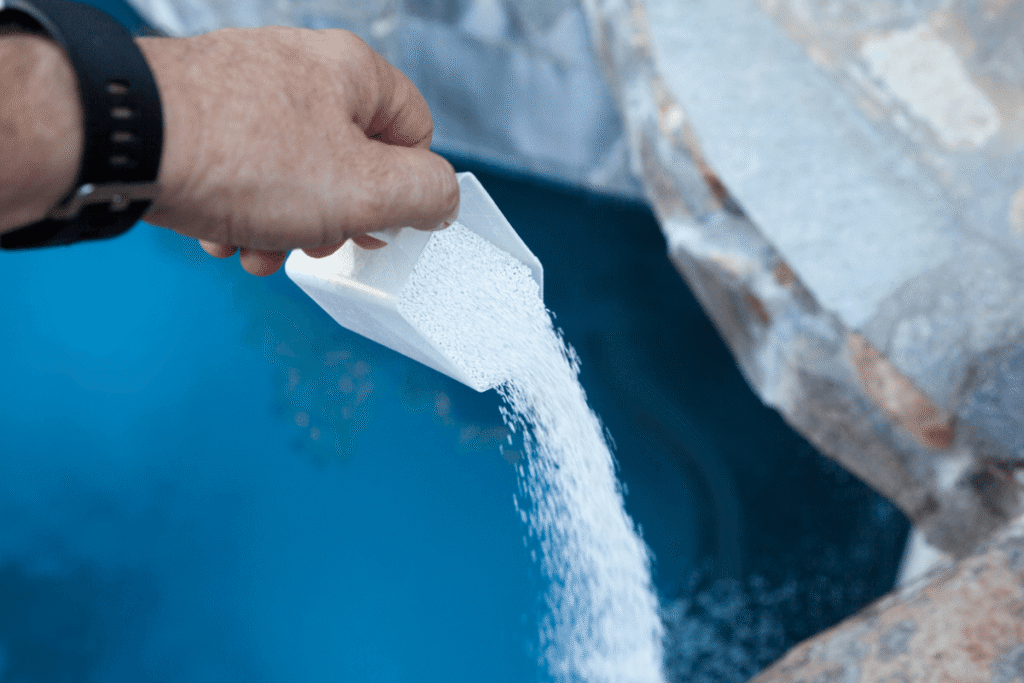
If the alkalinity in your hot tub is low, a purpose-made alkalinity increaser (sodium bicarbonate-based) is the most reliable way to raise it. Follow the product’s dosage guidance for your hot tub’s volume, plus these 4 easy steps:
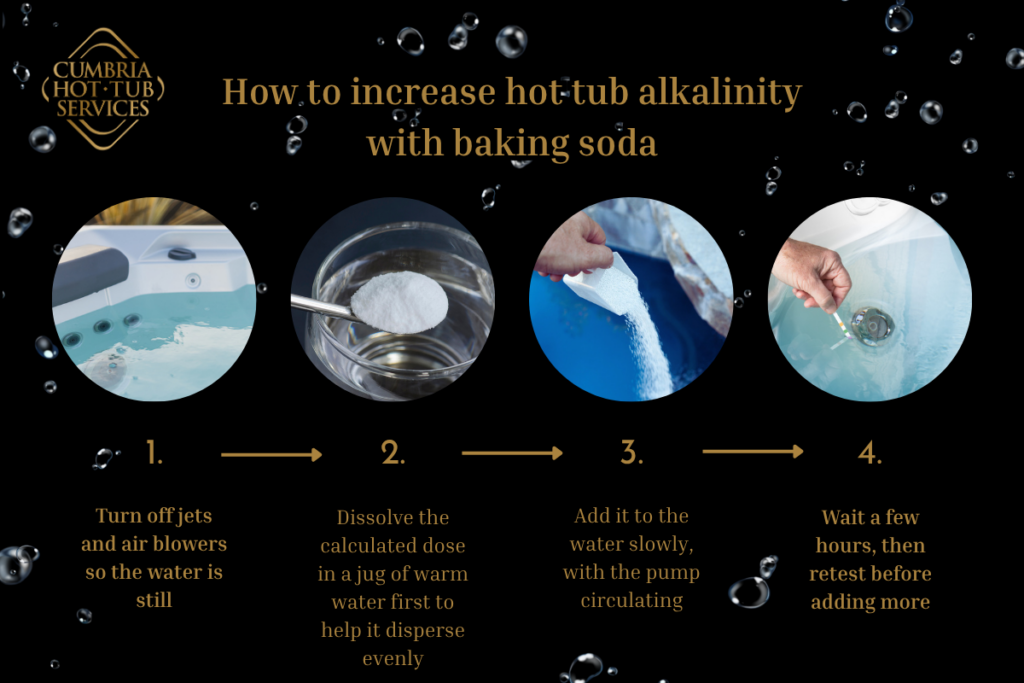
How to increase hot tub alkalinity with baking soda

You can use ordinary sodium bicarbonate to increase the alkalinity of your hot tub in the same way as a shop-bought increaser. This makes it a reliable emergency fix. As a rough guide, 1kg of bicarbonate of soda raises alkalinity by about 10 ppm per 4,000 litres, but always confirm against your tub’s exact volume. 

Follow these steps:
Hot tub alkalinity dosage calculator

Use the table below as a quick reference for how much baking soda or increaser to add per 10 ppm rise, based on your hot tub’s water volume.
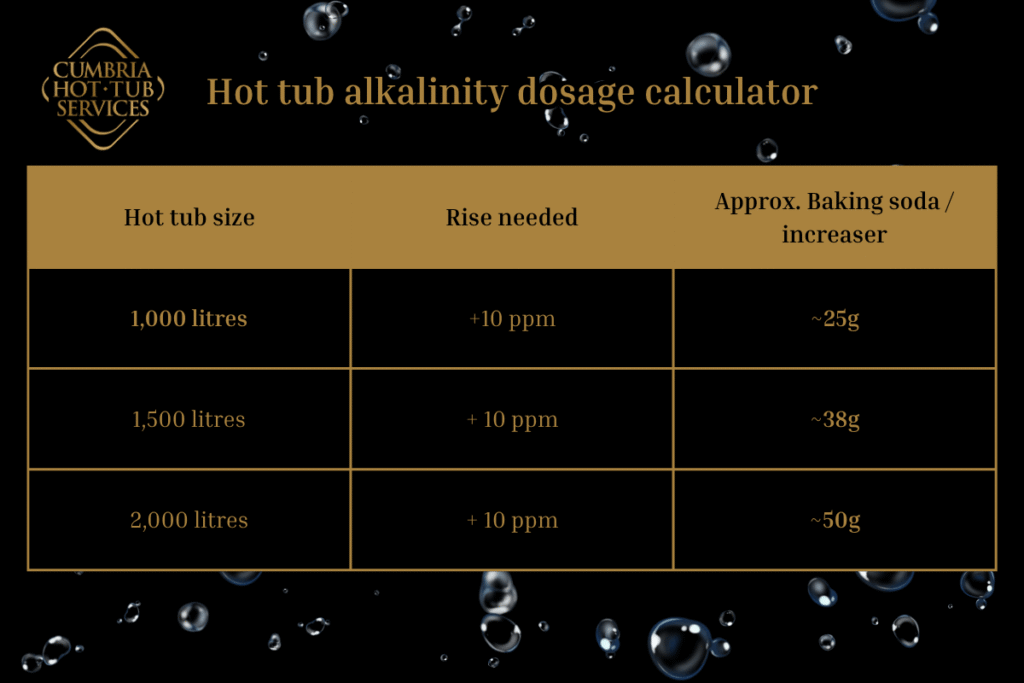
Always check your product label – formulations vary between brands.

Common mistakes when raising alkalinity

Most hot tub alkalinity problems come down to rushing the dosage or skipping the retest. Small, patient adjustments get better results than a single big correction. The mistakes below are the ones we see most often: 

  • Overdosing in one go. Add half the dose, retest, then top up if needed; a single full dose can push alkalinity too high and trigger the scaling and cloudy water that come with it.
  • Adding chemicals with jets running. This causes uneven mixing and foaming.
  • Not retesting. Alkalinity can take several hours to fully register on a test, so dosing again too soon risks overshooting into high alkalinity and needing a reducer to bring it back down.
  • Ignoring old water. If alkalinity won’t hold after 3-4 months’ use, total dissolved solids may be too high; a full water change often resolves it.
  • Relying on Trichlor tablets alone. These tablets are acidic and will keep pulling alkalinity back down; granules or bromine are more pH-neutral.

Related reading: If your pH levels keep drifting no matter what you try, it may point to a filtration or balance issue worth a professional look. Our Hot Tub Servicing page explains how we can help.

Get it right every time with Cumbria Hot Tub Services

Getting the alkalinity of your hot tub right through trial and error wastes both time and chemicals. So why not let a professional handle it for you?

A professional watercare visit with Cumbria Hot Tub Services rules out the guesswork and ensures proper dosing, HSG282-compliant testing for holiday lets, and live updates through our Servicing Portal. 

Explore our watercare plans or get in touch for a personalised plan for your hot tub and requirements.


What’s the difference between a hot tub and a Jacuzzi?

If you’re exploring buying a hot tub, you’ve probably noticed something quickly: the terms “hot tub” and “Jacuzzi” are used almost everywhere, often as if they mean the same thing.

But are they the same thing?

Many people search for “Jacuzzi” when they actually mean any type of hot tub. Others assume Jacuzzi is a separate, superior product category. 

In reality, the difference is much simpler – and understanding it properly can save you time, money, and a lot of unnecessary comparison headaches.

In this article, we break down the main difference between a jacuzzi and a hot tub. By the end, you’ll know exactly what you’re looking at and how to confidently decide which option is right for your home.

What is a hot tub?

A hot tub is a self-contained spa designed for warm water soaking, hydrotherapy jets, and relaxation. It’s the umbrella term for the entire product type, regardless of who makes it.

Hot tubs can vary widely in:

  • Size (2-person to 8+ person models)
  • Jet configuration and massage strength
  • Energy efficiency and insulation quality
  • Materials (acrylic, wood-clad, composite shells)
  • Features like LED lighting, Bluetooth audio, or smart controls

Recommended reading: Brush up on your hot tub maintenance and discover how to lower chlorine in a hot tub in 6 simple steps. 

What is a Jacuzzi?

Jacuzzi is a brand name. The company behind it, Jacuzzi Group, has been making hydrotherapy and spa products for decades and is one of the most recognised names in the industry.

Over time, the brand name became so well known that many people now use “Jacuzzi” as a shorthand for any hot tub. 

Jacuzzi-branded products typically include:

  • Hot tubs (portable spas)
  • Built-in whirlpool baths
  • Luxury spa systems with advanced hydrotherapy design

What’s the difference between a Jacuzzi and a hot tub​? 

Here’s the simplest way to understand the difference between a hot tub and a jacuzzi​: 

  • A hot tub is the general product category.
  • A Jacuzzi is a brand name that makes hot tubs (and other spa products).

People often say “Jacuzzi” the same way they might say “Hoover” for vacuum cleaners or “Sellotape” for sticky tape. 

But not every hot tub is a Jacuzzi, and understanding that difference matters when you’re comparing options or buying one.

If you search only for “Jacuzzi”, you limit yourself to one manufacturer. If you search “hot tub”, you’ll see the full market, including different brands. 

There are also practical differences when it comes to:

  • Price range. Jacuzzi-branded models often sit in the mid-to-premium range. Other hot tub brands may offer more budget-friendly or highly customisable options.
  • Features and design. Jacuzzi tends to emphasise engineered hydrotherapy and premium finishes. Other hot tub manufacturers may prioritise seating layouts, entertainment features, or energy efficiency.
  • Availability and choice. The hot tub market is broad, with many brands competing. Focusing only on Jacuzzi limits comparison shopping, especially if you’re looking for specific seating capacity, garden space fit, or installation requirements.

Is a Jacuzzi better than a hot tub?

This is where most of the confusion happens, but the question itself is slightly misleading.

A better way to ask it is:

“Is a Jacuzzi better than other hot tub brands?”

The answer depends on what you value. For example, a family-focused garden hot tub has very different priorities than a compact two-person spa for recovery after workouts.

A Jacuzzi-branded hot tub may be a good fit if you prioritise an established brand reputation.  However, other hot tub brands may be better if you want:

  • More competitive pricing
  • A wider range of sizes and layouts
  • Specific feature combinations (like party seating or swim jets)
  • Better energy efficiency options depending on the model

There isn’t a universal “best”. It’s about matching the product to how you’ll actually use it.

Which should you buy: a hot tub or a Jacuzzi?

When deciding whether to buy a hot tub or Jacuzzi, remember: you’re not choosing between two different things. You’re choosing between:

  • The entire hot tub market, or;
  • A specific brand within that market (Jacuzzi)

So the real buying question becomes:

What kind of hot tub do you need, and which brand offers the best fit for your budget, space, and lifestyle?

Here’s a practical way to approach it:

  • Start with how you’ll use it. Is it for winding down in the evening, hosting friends, family time, or hydrotherapy for sore muscles? Also, think about how many people will realistically use it at once. Knowing how many people will use it will guide the size, seating layout, and jet configuration you need.
  • Check your space and installation requirements. Alongside measuring whether it fits in the garden, consider access for delivery, a suitable base (such as reinforced decking or concrete), and proximity to a power source. These practical constraints often narrow your options faster than brand preference ever will.
  • Look beyond the purchase price. Energy efficiency, insulation quality, and ongoing maintenance costs matter just as much as the upfront cost. A cheaper model can end up costing more over time if it’s less efficient to heat or requires more upkeep.

Find your perfect hot tub today 

The confusion between “hot tub” and “Jacuzzi” is completely understandable, given the brand has become so well known that it’s often used as a generic term.

If you’re researching seriously, focusing on “hot tubs” rather than just “Jacuzzi” will give you a clearer view of price ranges, features, and installation options. Then, you can decide whether a Jacuzzi-branded model or another manufacturer best fits your needs.

Why not browse a curated hot tub range from a specialist like Cumbria Hot Tub Services?  Compare different models in one place and get a clearer sense of what works for your space, budget, and lifestyle. 

Take a look at our hot tubs for sale or find out more about our hot tub servicing.